

The appeal of East Texas land is easy to understand. Towering pines, peaceful backroads, and wide-open acreage create the perfect setting for a custom home, small farm, or private retreat.
For many buyers, the idea of building exactly what they want—without the restrictions of dense neighborhoods—is what makes rural property so attractive. Hallsville sits just east of Longview and has quietly become one of the most sought-after rural communities in the region.
Families are drawn to its strong schools, relaxed pace of life, and convenient access to nearby job centers. That steady growth has made land ownership here both a lifestyle choice and a smart long-term investment.

Still, purchasing rural property comes with a different set of considerations than buying an existing home in town. Access to utilities, zoning regulations, soil conditions, and property boundaries can all affect how easily your land can be developed.
Understanding these factors is essential before buying land in Hallsville, TX, especially as demand continues rising for Hallsville acreage for sale.
What Should You Know Before Buying Land in Hallsville, TX?
Before buying land in Hallsville, TX, verify road access, utility availability, and soil suitability for septic systems.
Buyers should review Harrison County zoning laws, estimate Texas rural land utility costs like wells and septic installation, and understand how strong Hallsville ISD property growth influences land demand and long-term resale value.

How Does Hallsville ISD Property Growth Affect Land Values?
The School District Premium
One of the biggest drivers behind Hallsville’s real estate demand is the reputation of Hallsville Independent School District.
Families across East Texas consistently rank the district among the strongest in the region, which has created a steady stream of buyers relocating from nearby Longview and other surrounding communities.
This movement has had a noticeable effect on land prices. As families search for homes within district boundaries, the supply of available housing tightens. Builders and buyers alike begin looking toward undeveloped land as an opportunity to create new housing inventory.
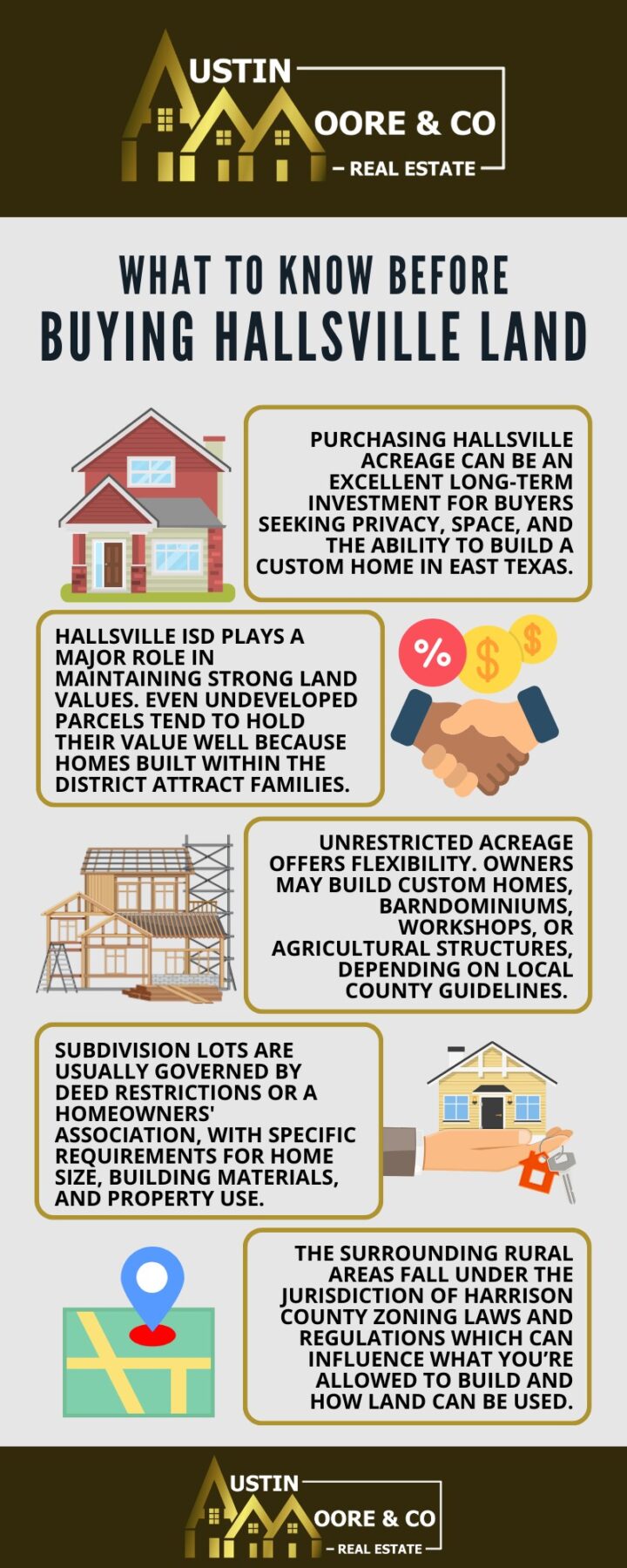
Because of this demand, Hallsville ISD property growth plays a major role in maintaining strong land values. Even undeveloped parcels tend to hold their value well because buyers know that homes built within the district will continue attracting families.

Long-Term Appreciation
For land investors and future homeowners alike, location inside the district offers a significant advantage. Historically, school quality has been one of the most consistent drivers of residential property demand.
Purchasing Hallsville acreage for sale within the district boundaries can act as a buffer during slower market cycles. Even when broader real estate markets cool, desirable school districts continue attracting buyers.
That stability helps protect land values and ensures strong resale potential once a home is built.
Understanding Harrison County Zoning Laws and Restrictions
Unrestricted vs Restricted Land
One of the most important decisions buyers face when purchasing rural property is choosing between unrestricted land and property inside a planned subdivision.
Unrestricted acreage typically offers the most flexibility. Owners may build custom homes, barndominiums, workshops, or agricultural structures, depending on local county guidelines. For buyers seeking privacy and independence, this option often provides the most freedom.
Subdivision lots, on the other hand, are usually governed by deed restrictions or a homeowners’ association. These communities often have specific requirements for home size, building materials, and property use.
While these guidelines help maintain property values, they can limit certain building styles or agricultural activities. Understanding which type of property best fits your long-term plans is essential before closing on a land purchase.

Local Ordinances
While Hallsville itself maintains a small-town atmosphere, the surrounding rural areas fall under the jurisdiction of Harrison County zoning laws and regulations. These rules can influence what you’re allowed to build and how land can be used.
For example, buyers should confirm whether mobile homes or manufactured housing are permitted on the property. Some parcels allow them freely, while others prohibit them through deed restrictions.
Livestock allowances and agricultural exemptions are also worth reviewing. Texas offers valuable tax benefits for qualifying agricultural land, but maintaining those exemptions requires specific land use activities.
Finally, buyers interested in building a barndominium—a popular option across East Texas—should verify that local guidelines allow this type of construction before purchasing.
Estimating Texas Rural Land Utility Costs
Water and Sewer Realities
Unlike urban neighborhoods, rural properties outside Hallsville rarely connect to city water or municipal sewer systems. Instead, most homes rely on private infrastructure.
This means buyers must budget for Texas rural land utility costs, which often include drilling a water well and installing a septic system. Well drilling costs vary depending on depth and soil conditions, but in East Texas, they commonly range from several thousand dollars to well over $10,000.
Septic systems also vary depending on soil composition. Some properties qualify for conventional septic systems, while others require aerobic systems, which tend to be more expensive but work better in certain soil conditions.
Before purchasing land, buyers should confirm whether a soil test or “perc test” has already been completed. This evaluation determines what type of septic system the land can support.
Power and Internet Access
Another critical step is verifying access to electricity. In many rural areas, electric service may be available at the road but not yet extended to the building site.
If your future home will sit several hundred feet—or even several thousand feet—from the nearest power pole, installation costs can increase quickly. Extending electrical lines down a long driveway may add thousands to your overall building budget.
High-speed internet is another consideration that many buyers overlook. While rural connectivity has improved in recent years, service availability still varies depending on location.
Some properties rely on fiber-optic service, while others use wireless or satellite internet providers. Checking service availability before purchasing land ensures your future home will have the connectivity needed for work, school, and entertainment.
Land Buying Considerations Table
| Consideration | Raw Unrestricted Acreage | Platted Subdivision Lot |
|---|---|---|
| Initial Purchase Price | Generally Lower | Generally Higher |
| Utility Hookups | Buyer Must Install (Well/Septic) | Often Pre-Installed or at the Street |
| Building Rules | Minimal (County Guidelines) | Strict (HOA and Deed Restrictions) |
| Road Access | May Require Clearing/Paving | Paved County or Private Road |
This comparison highlights one of the most important realities of land purchases: lower upfront prices often mean higher development costs later. Understanding these tradeoffs helps buyers make informed decisions based on their long-term plans.
Key Takeaway
Purchasing Hallsville acreage for sale can be an excellent long-term investment for buyers seeking privacy, space, and the ability to build a custom home in East Texas. The key is approaching the purchase with the same diligence you would apply to any major real estate decision.
Taking time to research Harrison County zoning laws, estimating Texas rural land utility costs, and understanding the impact of Hallsville ISD property growth will help you avoid surprises and position your investment for success.
With proper planning and due diligence, buying land in Hallsville TX can be the first step toward building your ideal rural homestead.
Frequently Asked Questions
How much does it cost to drill a water well in Harrison County?
Costs vary depending on well depth and drilling conditions, but most East Texas residential wells typically range between $5,000 and $15,000.
What are the requirements for an agricultural tax exemption in Texas?
To qualify for an agricultural exemption, land must be actively used for agricultural purposes such as livestock grazing, hay production, or timber management. Specific requirements vary by county appraisal district.
Are barndominiums allowed on all rural properties in Hallsville?
Not necessarily. Some areas allow them freely, while others may restrict them through deed restrictions or subdivision guidelines.
How do I verify the property boundaries before buying land?
Hiring a licensed surveyor is the most reliable way to confirm property lines and ensure no encroachments exist.
What internet providers service the rural areas outside of Hallsville?
Availability varies by location but may include fiber providers, wireless broadband services, and satellite internet options.
Is it difficult to get a construction loan for raw land in East Texas?
Construction loans are available but often require detailed building plans, contractor estimates, and larger down payments compared to traditional mortgages.
Do I need a soil test before installing a septic system in Harrison County?
Yes. A soil evaluation or percolation test is typically required to determine which septic system type is suitable for the property.
Ready to Explore Land Opportunities?
If you’re considering rural property in East Texas, having the right guidance can make all the difference. From evaluating utilities and zoning to identifying promising parcels, a knowledgeable local real estate professional can help you navigate every step of the process.
To learn more about available properties or to explore current Hallsville acreage for sale, contact our team at 903-500-0017 or email austin@austinmooreandcompany.com.